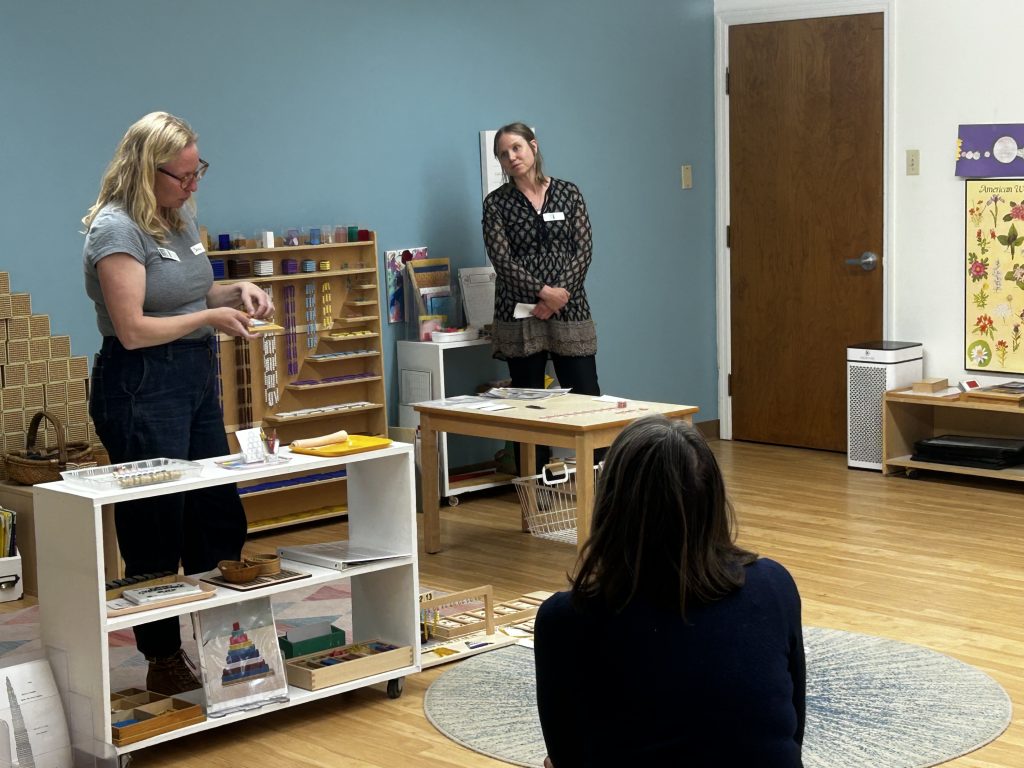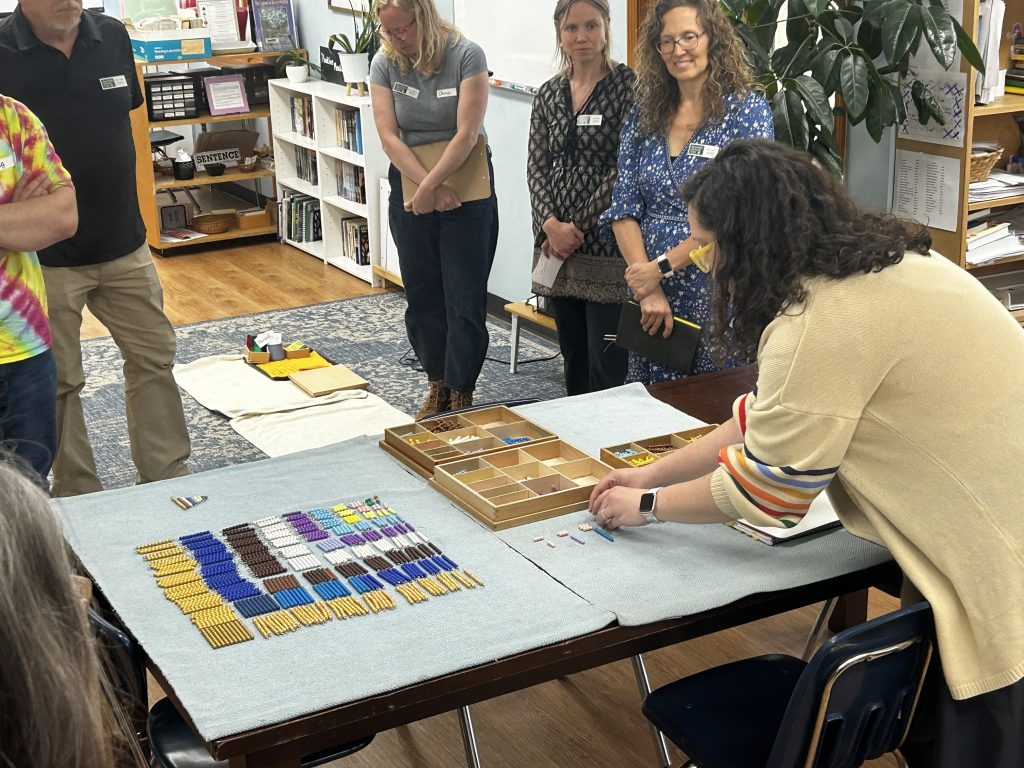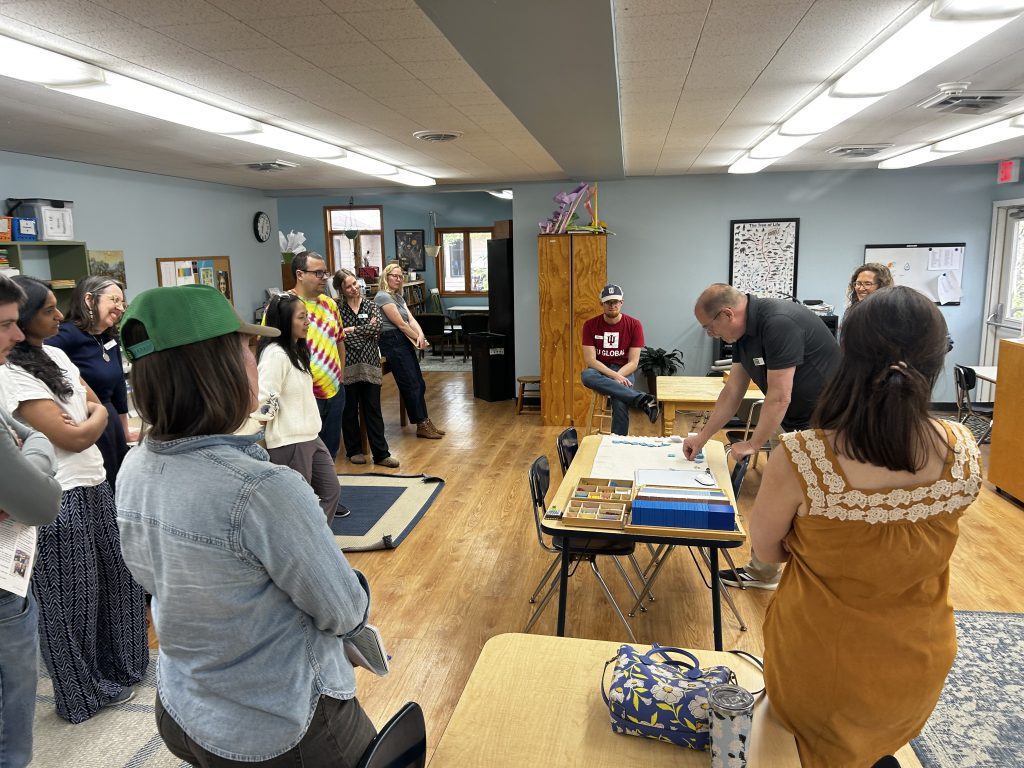
Thank you to all the parents who attended the math forum last night! And thank you to the Lead Teachers for a great presentation with demonstrations of materials across the nine years.
In this presentation, we covered five research-backed and Montessori-aligned principles of mathematics education:
- Math is about thinking skills, not just getting the right answer. Students truly, conceptually understand math when they can explain how they got their answer, use multiple strategies, understand and use multiple representations of a given concept, and make their own connections. A child who can explain their thinking is learning more deeply than one that just memorizes steps.
- Struggle is a normal and important part of learning math. Productive struggle builds stronger brain connections and refines understanding. Quick help reduces long-term learning.
- Memorization alone is not enough. Fluency matters, but after understanding! Conceptual understanding is essential for designing strategies, understanding place value and relationships, and developing mental math skills. Research shows that conceptual understanding builds long-term fluency; pure drill results in fragile knowledge
- Math learning is developmental. We start with a concrete understanding using physical materials, then move to a representational understanding (drawings and models), then an abstract understanding (algorithms of numbers and symbols). If we skip steps, we may miss conceptual understanding and only provide shallow learning.
- There are foundational goals of elementary math: number sense, logical reasoning, conceptual foundations, and confidence with problem solving. These need to be well-developed to set future math learning up for success. Strength with these foundational skills predicts later success far more than early acceleration.
We went on to discuss how Montessori is a natural complement to these principles. Montessori provides:
- A blend of explicit instruction and open-ended inquiry.
- A systematic progression of curriculum
- A culture of growth mindset to help develop math positivity
- Individualized lessons for targeted productive struggle
- Hands-on materials for conceptual understanding
The Montessori three-period lesson provides strong explicit instruction through:
- Predictable routines and lesson structures
- Gradual release of responsibility
- Multiple representations for generalization
- Systematic sequence
- Hands-on materials
Dr. Montessori wrote, “What the hand does, the mind remembers.”
This parent forum was one of the culminating works of our staff curricular review. We are always striving for continuous improvement. This was year one of a two-year deep dive into math. We have been talking a lot about the balance of explicit instruction and open inquiry in mathematics and decided the topic was too big for one year. This year we focused on reviewing and updating the curriculum as needed, and fine-tuning our explicit instruction practices. Next year we will focus on a culture of math positivity and inquiry.
As part of our curricular review, we had a staff book discussion on Montessori Math: Maintaining the Magic While Addressing What’s Missing. A staff member went to the Stanford You Cubed Mathematical Mindset Leadership Summit and completed four accompanying online courses, and two staff members attended Mathematical Discourse in Montessori by Dr. Laura Saylor at the 2025 UMSI conference. All staff participated in a workshop on campus targeting teacher language that elicits conceptual understanding and generalization in math lessons and the development of mathematical mindset, as well as small group mathematical mindset activities throughout the spring. We will be collecting data on our new initiatives this spring and next year to gauge effectiveness.
Stay tuned for next year’s forum on mathematical inquiry!